
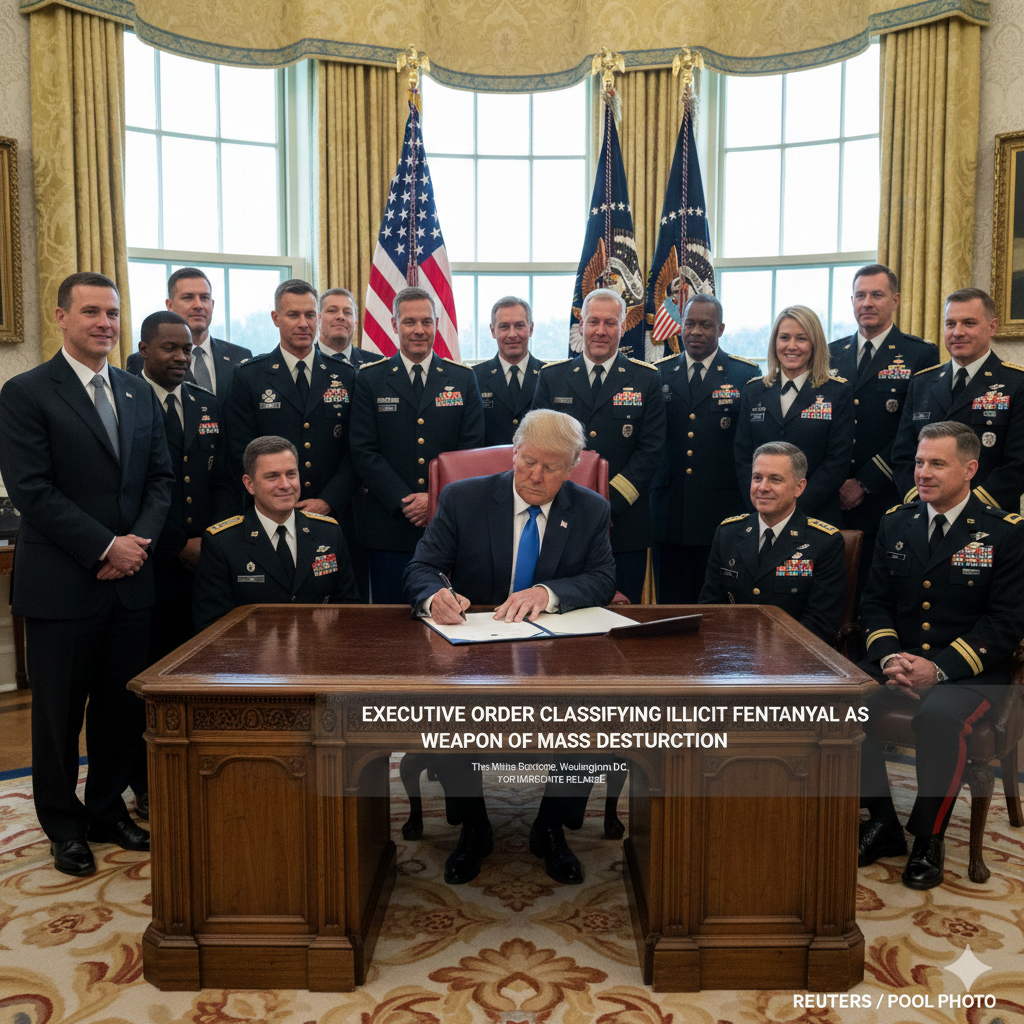
There is no settled U.S. statutory classification that defines illicit fentanyl as a Weapon of Mass Destruction (WMD). When headlines state that Trump signed an executive order classifying illicit fentanyl as a WMD, they refer to a policy action or proposed executive interpretation, not an automatic change to existing federal law such as the Chemical Weapons Convention Implementation Act or 18 U.S.C. § 2332a. Any such executive order would expand enforcement posture and national security framing, not rewrite congressional statutes
What the Executive Order Claims
The executive order reportedly signed by Donald Trump frames illicit fentanyl as a national security threat equivalent to a Weapon of Mass Destruction, emphasizing scale of death rather than method of delivery.
This framing does not automatically amend federal criminal statutes, but it directs agencies to treat fentanyl trafficking with WMD-level urgency.
What “Weapon of Mass Destruction” Means in U.S. Law
Under 18 U.S.C. § 2332a, a WMD includes:
- Chemical weapons
- Biological agents
- Nuclear devices
- Radiological dispersal mechanisms
Fentanyl is not listed by name, and classification requires intent to use as a weapon, not merely lethal potential.
Why Fentanyl Is Being Compared to WMDs
The comparison is driven by scale of fatalities, not delivery mechanism.
- 74,702 deaths involved synthetic opioids in 2023 (CDC)
- Fentanyl caused more annual U.S. deaths than all terrorist attacks combined since 2001
The administration argues that mass lethality justifies mass-destruction framing.
Overdose Data Driving the Policy Shift
Synthetic opioids account for ~68% of all overdose deaths.
Key metrics:
- 2 mg of fentanyl can be fatal
- 1 kg contains 500,000 potentially lethal doses
- Trafficking volumes exceed multi-ton seizure thresholds annually
Executive Orders vs Congressional Statutes
An executive order:
- Directs federal agencies
- Sets enforcement priorities
- Interprets existing law
It cannot:
- Create new crimes
- Redefine statutory WMD definitions
- Bypass courts
What the Order Can Legally Do
The order can:
- Prioritize fentanyl as a national security threat
- Expand interagency task forces
- Enable terrorism-linked financial investigations
- Increase foreign sanctions
What the Order Cannot Legally Do
The order cannot:
- Automatically prosecute traffickers as WMD terrorists
- Deploy the military domestically without separate authority
- Override Controlled Substances Act classifications
Role of the DEA Under the Order
The DEA gains:
- Elevated intelligence coordination
- Expanded chemical precursor tracking
- Enhanced international operations authority
Role of DHS and Border Enforcement
Customs and Border Protection (CBP) may:
- Increase chemical detection technology
- Expand port-of-entry inspections
- Prioritize fentanyl precursor interdiction
Terrorism Statutes and Drug Trafficking
WMD classification attempts to unlock:
- Material support statutes
- Anti-terrorism financing laws
- Extended sentencing ranges
Courts still require terrorist intent.
Narco-Terrorism: Legal Thresholds
To qualify as narco-terrorism:
- Violence must coerce a population or government
- Profit alone is insufficient
- Cartel brutality may qualify only if intent is proven
Asset Seizure and Financial Warfare
The order strengthens:
- Civil asset forfeiture
- Bank secrecy enforcement
- Cryptocurrency tracing
International Supply Chains: China & Mexico
Fentanyl pipeline:
- Precursors from China
- Synthesis in Mexico
- Distribution via U.S. networks
Diplomatic pressure increases under WMD framing.
Chemical Weapons Convention Constraints
The CWC regulates weaponized chemicals.
Fentanyl:
- Is pharmaceutical in origin
- Lacks battlefield delivery intent
Thus, international WMD designation is unlikely.
Military vs Law Enforcement Boundaries
Despite rhetoric:
- Posse Comitatus Act remains
- Military action requires congressional authorization
- Law enforcement remains primary
Impact on Sentencing and Prosecution
Prosecutors may seek:
- Enhanced conspiracy charges
- Terror-linked enhancements
- Life sentences in extreme cases
Judicial scrutiny remains strict.
Civil Liberties and Due Process Concerns
Critics warn of:
- Overbroad terrorism labels
- Expanded surveillance
- Reduced evidentiary thresholds
Public Health Community Response
Health experts argue:
- Addiction is medical, not military
- WMD framing discourages treatment
- Harm reduction may be undermined
State-Level Legal Conflicts
States retain:
- Drug policy autonomy
- Sentencing discretion
- Treatment-first models
Federal-state tension is expected.
Historical Precedents (Anthrax, Ricin)
True chemical WMD cases involved:
- Intentional poisoning
- Targeted attacks
- Weaponized dispersal
Fentanyl trafficking differs fundamentally.
Election-Year Political Context
The order:
- Signals toughness on crime
- Appeals to national security voters
- Reframes opioid crisis rhetorically
Media Framing vs Legal Reality
Headlines simplify.
Law remains complex.
Courts—not press releases—decide classification.
Likelihood of Court Challenges
High probability of:
- Constitutional challenges
- Statutory interpretation disputes
- Federal overreach claims
Long-Term Policy Implications
Potential outcomes:
- Expanded sanctions regime
- More aggressive prosecutions
- Limited judicial adoption of WMD theory
Final Legal and Strategic Assessment
Classifying illicit fentanyl as a Weapon of Mass Destruction is a strategic enforcement signal, not a legal redefinition. The executive order reshapes priorities, intensifies pressure, and tests legal boundaries, but does not transform fentanyl into a statutory WMD without Congress.


